What a Komatsu 490 Excavator Taught Me About OEM vs Private Label Backhoe Loaders
You ever have a spreadsheet moment where the numbers line up in a way that hurts?
I'm a procurement manager at a 60-person earthworks company in the Upper Midwest. I've managed our equipment budget—roughly $1.8 million annually—for seven years. Every order, every repair, every rental, it's all in the same cost-tracking system. When I closed out the books for 2024, I found we'd spent $31,000 on what I call "avoidable equipment costs." Breakdowns, emergency rentals, lost crew time—the stuff that a better procurement decision would have prevented.
That's a lot of money. But honestly, the mistakes taught me more than any of the purchases that went right.
It Started With a Fleet at 9,000 Hours
In early 2024, our backlog was up 40% year over year. The problem: three of our primary machines were all crossing the 9,000-hour mark in the same quarter. One excavator, one dozer, one backhoe loader. We'd been extending maintenance intervals to keep them alive, but you can't do that forever and still call yourself a professional contractor.
So the shopping list went to the ownership group: one large excavator for a highway project, one dozer for site prep, two mini excavators for residential and utility work, and one backhoe loader for pipe and grading. Total approved spend: $1.2 million.
I had 90 days to get it right.
The Komatsu 490 Excavator: When Specs Make the Difference
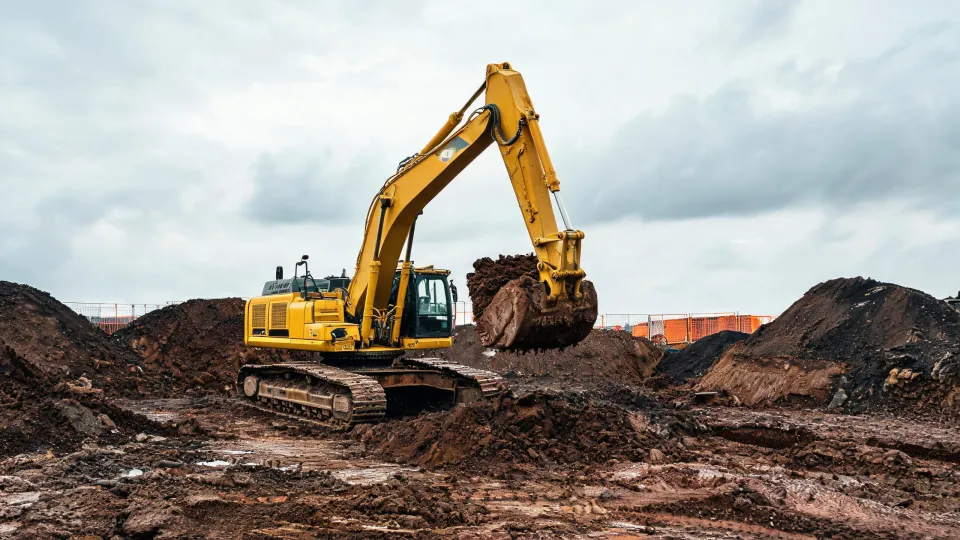
The centerpiece was the Komatsu 490 excavator. Specifically, the PC490LC-11. According to Komatsu's published specifications at komatsu.com, that machine carries an operating weight of roughly 49,000 kg, puts out 257 kW from its Komatsu engine, and moves buckets from 1.9 to 2.6 cubic meters depending on configuration. For a contractor moving clay and crushed stone on a state highway project, it's the right class of machine.
What mattered to me, though—what I nearly got wrong—was the arm configuration.
Dennis, our Komatsu dealer's rep and one of the more honest equipment salesmen I've met, asked me a question I didn't expect. "What material are you actually going to move?"
"Clay and crushed stone," I said. "Fifty-fifty."
He opened the spec sheet and walked me through the math. With that material density and a 7.5-meter dig depth, the heavy-duty arm with a 2.2-cubic-meter bucket gave the best cycle balance. The standard arm would work, but the material weight would slow the swing. Over 2,000 hours a year, that efficiency gap becomes real money.
The heavy-duty arm package cost about 4% more. I remember doing the mental math and almost saying no. He said something I wrote down in my procurement notebook, word for word:
"You can save half a load every cycle, or you can save once on the invoice. Either way, you'll find out."
I signed for the heavy-duty arm. And after watching that machine load trucks six days a week for the first three months, I believe him. I do not have a controlled study to show you—sample size of one, and I'm not a data scientist. But in our fuel and tonnage tracking, the 490 is our most cost-effective excavator.
That's the rule I should have followed on every purchase after it: verify the spec, not the sticker.
The Dozer: An Easy Call
The dozer was the least dramatic purchase of the year. We went with a Komatsu D61. I don't have an exciting story about it, because there wasn't one. The dealer had two in inventory, the parts counter had what we needed, and our operator came back from the demo and gave it the same review he gives every machine: "It's fine. Get it."
If you ask me, the used equipment market is a better truth-teller than any brochure. Komatsu dozers hold their value because the support network is deep. Dealers stock parts, technicians know the machines, and the auction data reflects that. None of that is luck.
Nothing about the dozer taught me anything new. The other machines did.
The Mini Excavator OEM Lesson: I Didn't Listen
For the mini excavators, we needed two machines in the 3.5-ton class. This is the category where the market gets crowded with OEMs, private labels, and rebranded imports, and the price differences can be significant.
We took bids from three vendors. One dealership quoted a Komatsu PC35MR-5. Another came in with a private-label mini excavator at $8,000 per machine less, with suspiciously similar specs.
Same operating weight. Same dig depth. Roughly the same breakout force. On paper, you'd have to be crazy to pay $8,000 more for the Komatsu.
Dennis gave me a warning at that point, and I nearly ignored it. "Check the parts lead time," he said. "Not the brochure. Not the spec sheet. Call the parts counter and ask how long a hydraulic pump takes to get. Then decide."
I didn't call.
The private-label mini ran fine for five months. Then a hydraulic hose failed. It was a $140 hose.
And the dealer that sold the machine didn't stock it. The factory was overseas. Backorder. Ten days.
Ten days of rental on a replacement mini excavator cost us about $3,400. Plus the schedule slip on a foundation job where the inspectors were already booked. The $8,000 savings evaporated in one hose failure.
See, the thing about OEM versus private label is not always about build quality. That machine was fine. The system around the machine wasn't. There was no parts network, no factory-backed support, no one standing behind it.
They warned me. I didn't listen. That's on me.
Backhoe Loader OEM vs Private Label: When a $17,000 Discount Cost Us $35,000
This one stings more because the number is bigger.
For the backhoe loader, we planned to buy a Komatsu from Dennis. But a regional equipment distributor came in with a private-label backhoe loader priced $17,000 below the Komatsu. On a machine that's already a smaller line item, that discount was hard to ignore.
Their sales rep made it easy, too. "Same class. Same dig depth. Same machine underneath, different stickers. You're paying for a plastered name with the Komatsu."
I wanted to believe him. So I did.
At 470 hours, the transmission linkage failed. Not the transmission—a small linkage arm with a bushing that costs about $140. The machine went into our shop, and our mechanic called the distributor. No part in stock. No firm ship date from the factory.
Six weeks.
Our backhoe loader sat on our shop floor for six weeks waiting for a $140 part.
We rented a replacement at $4,500 a week for four weeks while we finished the project we'd bid with our own machine. That's $18,000. Add the labor that went idle when we had to rework the schedule—call it $6,000. Then there was the resale hit: when I sold that machine in early 2025, we took $11,000 less than a brand-name unit with the same hours would have brought.
- Saved on purchase: $17,000
- Rentals and lost labor: $24,000
- Resale loss: $11,000
Net result: the "cheap" machine cost us $18,000 more than the Komatsu would have cost. That's not an estimate. That's the number in the cost tracker.
I only believed in total cost of ownership after ignoring it. And it was expensive to learn.
What I Do Now
We did eventually buy the Komatsu backhoe loader, and I replaced both private-label minis with Komatsu units. That's not brand loyalty talking. It's the math.
Here's the checklist I use now, and I'm happy to share it:
- Price is what you pay. TCO is what it costs. The sticker discount is the first page of the story, not the last. Add in parts lead times, rental coverage, and a realistic resale forecast.
- Buy the system, not just the iron. An OEM machine sold through a dealer that stocks parts and knows the model is not the same purchase as a private label from a distributor whose nearest warehouse is 200 miles away. The machines may be identical. The support systems aren't.
- Trust the vendor who says "check us carefully." Dennis told us to verify parts lead times even when it meant we might look elsewhere. He acknowledged the boundaries of his product category and his inventory. That honesty earned him our trust—and, eventually, our business on the machines that really matter.
- Match the machine to the work. The 490 with the heavy-duty arm was the right call because of material density, not because of a brochure. The same logic should apply to every machine on the list.
We've now standardized around the equipment types we run at real volume: Komatsu excavators, dozers, and wheel loaders. For machines we use occasionally, we rent from the dealer instead of buying on price from a seller who can't back it up.
When I re-ran the avoidable-cost report in Q4 2024, the number had dropped about 80% compared to our first-half average. The savings paid for our 2025 budget increase. I'm not saying the system is perfect—I'm saying it's a lot harder to make the same mistake twice when the spreadsheet tracks every consequence.
So if you're sitting on an equipment decision right now, and someone is offering you a deal that's $17,000 better, do me one favor before you sign: call the parts counter and ask about the $140 part. Ask how long it takes to get. Ask what happens when it breaks.
I wish I had.